From Matter Data to Management Letter: How AI Report Drafting Works for Professional Services Firms
Every client engagement ends with a deliverable. At a boutique Thai professional services firm, that deliverable is usually a management letter, an engagement summary, a board report, or an advice memorandum. It is the moment when the work the firm has done becomes visible to the client in one place. It is also, for most fee earners, one of the most time-consuming parts of the engagement to produce.
The paradox is that the information is already there. By the time a fee earner sits down to draft the report, the matter record contains the intake details, the meeting summaries, the document findings, the action items completed, and the billing log. Everything the report needs exists somewhere in the system. The drafting problem is not a writing problem. It is an assembly problem.
Where Report Drafting Time Actually Goes
A fee earner drafting a management letter for a three-month engagement will typically spend 20 to 30 percent of the total drafting time not writing, but locating. Finding the note from the second client meeting that contained the key finding. Pulling the billing summary for the right date range. Cross-referencing the document review output from six weeks ago with the verbal update given two weeks later. Checking whether the action item flagged in meeting three was resolved before the final meeting.
This location and assembly work is invisible in the final product. The client sees the letter, not the time spent reconstructing the record it was built from. But for the fee earner, it is a real and significant overhead, particularly at boutique firms where there is no dedicated research assistant or junior drafter to do the retrieval work.
The time cost compounds when the matter record is incomplete or inconsistent. If meeting notes were not written up promptly, if the document finding was captured in an email rather than the matter file, or if the billing log has gaps from weeks where time was not recorded carefully, the fee earner spends additional time reconciling what the record says with what actually happened. The report draft that should take two hours takes four or five.
What a Complete Matter Record Makes Possible
The case for building a clean matter record throughout an engagement, rather than assembling one at the end, is clearest at report drafting time. A matter where every client meeting generated a structured summary, every document upload produced an AI-assisted finding, and every action item was tracked to resolution contains everything a report needs in a form that is ready to use.
From that kind of record, the assembly step is fast. The meeting summaries are already written in a consistent structure. The document findings are already extracted and linked to the relevant matter dates. The billing log is already accurate and complete. A first draft of the report is not built from scratch; it is generated from the structured data that the matter record contains.
This is what AI-assisted report drafting actually does. It does not write the report from imagination. It reads the matter record, pulls the relevant data points, organises them in the structure the report requires, and produces a first draft that reflects what the engagement actually involved. The professional then reviews that draft, applies their judgement, refines the language, and adds the interpretive layer that cannot come from a data pull.
The Blank-Page Problem
Every fee earner who has drafted a professional report knows the blank-page problem. The cursor is positioned at the top of a new document. The matter record is open in another window. The question is how to begin, what to include, and how to structure something coherent from a collection of notes and findings that were not written with the report in mind.
AI-generated first drafts eliminate this problem. The draft arrives with a structure already in place. The key findings are identified. The chronology is assembled. The sections are populated with the relevant matter data. The professional does not have to decide where to start because the starting point is already provided.
This does not mean the draft is finished. It means the work has shifted from blank-page assembly to substantive review and refinement, which is a significantly more efficient use of a senior professional’s time. The draft gives the reviewer something to react to, correct, and improve, rather than something to create from nothing.
The quality difference between a report written against a complete, well-structured matter record and one written from a partially remembered engagement is also material. The complete record produces a report that is accurate and comprehensive. The partial record produces a report that reflects what the fee earner can recall, which may not be the same thing.
Consistency Across the Firm
For boutique professional services firms, branded consistency in client-facing output matters. A management letter from the firm should look like a management letter from the firm, regardless of whether it was drafted by the founding partner or a recently hired associate. The structure, the terminology, the format, and the level of detail should be consistent across engagements and across fee earners.
Manual drafting makes this difficult to enforce. Different fee earners have different writing styles, different ways of structuring a finding, different interpretations of what the report should contain. Partners who review drafts spend time on formatting and structural corrections that have nothing to do with the quality of the professional judgement being reported.
AI-assisted drafting produces output against a consistent template. The structure is always the same. The sections are always in the same order. The terminology reflects the firm’s preferred language. The partner reviewing the draft is looking at substance, not at whether someone remembered to include the section on outstanding action items or formatted the billing summary correctly.
This consistency also matters for clients. A firm whose reports look the same every engagement, regardless of which fee earner ran the matter, signals that the quality is not dependent on which individual was assigned. The deliverable is a firm product, not a personal one.
The Report as a Client Retention Moment
The management letter or engagement summary arrives at the end of the engagement, just before the question of renewal or next instruction. A client who receives a well-structured, timely, and accurate report that clearly reflects what was discussed, what was found, what was resolved, and what remains is in a different position to a client who receives a summary that appears to have been written quickly from incomplete notes.
The report is often the last substantive interaction before a client decides whether to continue with the firm. It is also the document they are most likely to share internally, to use in board discussions, or to refer to when evaluating whether the engagement delivered value. A report that reads as if the firm had a complete command of the matter, from first meeting to close, reinforces the relationship. A report that contains gaps or inconsistencies raises questions.
For Thai boutique firms where client relationships are built over years and engagements often extend across multiple matters, the quality of reporting is part of what a client is paying for. The report is not administrative output. It is a professional product that the client uses.
Connecting the Record to the Report
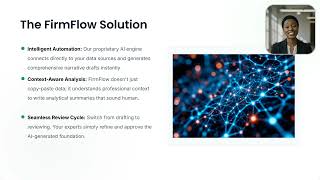
FirmFlow’s Report Drafting module pulls meeting summaries, matter timelines, document findings, and billing data from across the platform and drafts the first version of your report: branded and structured, ready to review in minutes rather than hours. The professional makes the judgement calls, refines the language, and approves the final version. The assembly work is done.
For boutique Thai firms where the same fee earner who ran the client meetings is also the one who writes the report, this is not a marginal efficiency gain. It is the difference between a report that takes a morning to draft and one that takes a day, and between a deliverable that reads as authoritative and one that reads as reconstructed.
The matter record built through FirmFlow, from intake to meetings to document analysis to billing log, is designed so that the report at the end is the natural output, not a separate exercise. The work of capturing the matter well throughout the engagement is also the work of producing the report efficiently at the end.
Read the full guide, it's free
Join thousands of Thai professionals getting practical firm management insights.