How Much Billable Time Are Thai Professional Firms Losing to Post-Meeting Admin?
Every client meeting ends the same way. The client leaves. The fee earner makes a few notes, sends a follow-up email, and moves to the next task. The meeting summary does not get written. The action items do not get captured. The billing entry does not get logged. The CRM record does not get updated. These things will happen later, in the gaps between other work, or not at all.
For boutique professional services firms, this is not an occasional failure. It is the routine. And its cost, measured in unbilled hours and unrecorded time, is one of the largest sources of leakage in a 5 to 15 person practice.
What Post-Meeting Admin Actually Involves
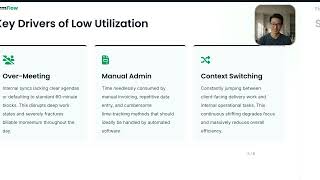
Post-meeting administration at a typical boutique firm is not a single task. It is a sequence: write up the meeting notes in a form useful to a colleague, extract the action items and assign them, estimate the time spent and create a billing log entry, update the CRM with a record of the interaction, and decide whether anything from the meeting needs to be added to the matter file.
Done carefully, that sequence takes 20 to 40 minutes per meeting. A fee earner with three client meetings in a day is looking at up to two hours of post-meeting admin before producing a single billable output from those meetings.
In practice, the time pressure of a busy day means this sequence is compressed, deferred, or abandoned. Notes written quickly are often too thin to be useful to anyone else. Billing entries estimated from memory at the end of the week are often inaccurate. CRM records that do not get updated are invisible to colleagues who pick up the matter later.
The Scale of the Leakage
The arithmetic is worth doing explicitly. A 5-person firm where each fee earner has three client meetings per week is running 15 client meetings weekly. If each meeting generates 30 minutes of post-meeting admin, that is 7.5 hours of administrative work per week across the team, none of it billable.
At a typical Thai professional services billing rate of ฿3,000 to ฿4,000 per hour, 7.5 hours of unbilled admin represents ฿22,500 to ฿30,000 per week in lost billing capacity. Annualised, that figure exceeds ฿1 million.
This is not money being charged and not paid. It is time being spent on administration rather than on work that generates revenue, every week, invisibly, because the system requires it.
The Problem of Time Recording Leakage
Parallel to the admin overhead is the time recording problem. Research across professional services firms consistently shows that 10 to 15 percent of billable time goes unrecorded. The cause is not dishonesty. It is friction: the billing entry is not logged at the moment the work happens, the fee earner relies on memory at the end of the day or week, and time that cannot be recalled is time that cannot be billed.
Post-meeting time is where this leakage is most pronounced. The meeting itself is clear and bounded: it started at 10am and ended at 11am. But the preparation, the follow-up email sent at 11:15am, the document review triggered by something the client raised, the five-minute call with a colleague to check on a point; none of these get captured automatically, and most of them are not reconstructed at billing time.
For a firm billing at ฿3,000 per hour per fee earner, a 12 percent time recording leakage across a 5-person team at 80 percent utilisation represents more than ฿800,000 per year in unbilled work. The number is large because the leakage is continuous and because professional services billing rates make each lost hour expensive.
Why Standalone Meeting Bots Do Not Solve the Problem
AI-powered transcription tools such as Fireflies, Otter, and their equivalents have been available for several years and are widely used in professional services. They solve the transcription problem: the meeting is recorded and a summary is produced. But they do not solve the integration problem, which is where most of the value actually lives.
When a meeting summary lives in Fireflies, the fee earner still has to open Fireflies, find the summary, copy the relevant points into the matter management system, create a billing entry manually, and update the CRM. The transcription step is automated. Every step after it is not.
This is the gap between a useful tool and a productive workflow. A standalone meeting bot reduces the effort of note-taking. It does not reduce the effort of connecting the meeting to the matter record, the billing system, and the next client interaction. For a boutique firm where every fee earner is also managing client relationships and business development, the administrative overhead of moving outputs between disconnected tools is the thing that actually determines whether the tool gets used consistently or only occasionally.
AI as Support, Not Replacement
For boutique professional services firms in Thailand, where professional judgement is the product and client relationships are built over years, the framing around AI in meetings matters as much as the capability.
The right framing is not that AI attends client meetings and produces records. It is that AI handles the mechanical first layer of post-meeting work, and the fee earner reviews and approves every output. The AI produces the summary: the fee earner confirms it captures the key points. The AI drafts the billing entry: the fee earner adjusts it for accuracy. The AI writes the CRM interaction record: the fee earner reviews it before it is saved.
This framing has practical value. Clients who know their adviser uses AI to manage post-meeting admin efficiently are generally comfortable with that. Clients who feel AI is involved in the substance of their matter without supervision are not. The distinction is worth preserving in how AI meeting tools are described and deployed.
The result of this model is not that the fee earner does less work. It is that they spend their time on judgement rather than transcription, on accuracy review rather than blank-page note-writing, and on client relationship rather than CRM entry.
Connecting Meetings to What Comes Next
FirmFlow joins your client meetings, transcribes them, extracts action items, drafts a billing log entry, and writes an interaction record to the CRM automatically. The fee earner reviews and approves each output. Post-meeting admin does not disappear entirely; the professional judgement step remains, but the mechanical work is done.
The billing entry is in the system the moment the meeting ends, not reconstructed from memory on Friday afternoon. The CRM record is updated before the fee earner’s next meeting, not discovered to be incomplete by a colleague picking up the matter six weeks later. The matter file reflects what was discussed, not what anyone happened to remember when they finally found time to write it up.
For a boutique firm where the same fee earner is adviser, account manager, and administrator, this is not a small operational gain. It is a structural change in how time is captured and how matters are managed. The meetings do not change. What happens after them does.
The Compounding Effect of Captured Time
The billable time recovery from AI-assisted meeting admin compounds over the life of a matter. A matter managed through three months of client meetings, each with a clean billing entry and a complete CRM record, produces an accurate billing summary at the end. The report draft draws on matter notes that reflect what actually happened. A billing dispute, if one arises, can be resolved against a complete record.
A matter managed through three months of post-meeting admin done manually, inconsistently, and partly from memory produces an approximate billing summary, a report draft that requires reconstruction work, and a client record that is only partially useful for the next engagement.
The investment in capturing time accurately from the first meeting pays forward through every subsequent interaction with that client.
Read the full guide, it's free
Join thousands of Thai professionals getting practical firm management insights.