Why PDF Intake Forms Are Costing Your Thai Firm More Than You Realise
Every new client engagement starts the same way at most Thai boutique firms. An email arrives. Someone follows up. A PDF form is attached, completed imperfectly, and returned. A staff member re-enters the data into the CRM. Someone checks for conflicts. Three days later, the client record exists. The matter has not started.
This sequence is so routine that most firms do not see it as a cost. But the administrative overhead of manual client intake is one of the most persistent sources of unbilled time and operational risk at boutique professional services practices. The problem is not that any single step is wrong. The problem is that there are too many steps, they are disconnected from one another, and every disconnection is a place where time is lost and errors are introduced.
The Real Cost of Getting a New Client on the Books
A typical manual intake at a boutique Thai firm follows a recognisable pattern. A potential client reaches out. The firm responds with an email and a PDF intake form. The client fills it in, often partially, and returns it. A staff member reviews what came back, identifies what is missing, and follows up again. Once the form is complete, the same staff member manually enters the client details into the CRM, creates a matter record, and passes the information to whoever is running the conflict check.
From first contact to a complete client record in the system, that sequence typically takes 2 to 3 days and involves 3 to 5 email exchanges, at least one manual data entry step, and a separate conflict check process.
For a 5-person firm handling 8 to 10 new matter enquiries per month, the intake overhead is not trivial. It consumes fee earner time that could be spent on billable work. And the time cost is the least of it.
Every Re-Entry Step Is a Risk
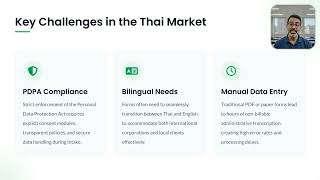
Data entry between disconnected systems is not a neutral act. Each time information moves from a PDF to a CRM record, or from an email to a matter file, it passes through a human intermediary who can misread, abbreviate, or simply omit a field. The more steps in the chain, the more opportunities for the record to drift from what the client actually provided.
In professional services, data quality in the client record is not a cosmetic concern. The contact details, entity structure, and matter description captured at intake are the foundation for engagement letters, billing records, conflict checks, and regulatory filings. An error introduced at intake does not stay isolated. It propagates forward through every document that draws on that record.
Correcting a data entry error later, once it has been carried through an engagement letter and a billing log, is significantly more expensive than getting the original entry right. And most errors are not caught until they surface in a client deliverable, which is the worst possible moment to discover them.
Conflict Checks Done Manually Are a Liability Problem
The conflict check is where manual intake creates the most serious risk for boutique law firms. A conflict of interest that is missed during intake, because the check was done by searching a spreadsheet from memory or scanning a CRM without any systematic methodology, is not a process failure. It is a professional liability exposure.
The problem is structural. In most boutique firms, conflict checks are informal: a fee earner or senior staff member thinks through existing clients, checks a list, and makes a judgement call. This works well when the firm is small and the principal knows every client personally. It becomes increasingly unreliable as the matter list grows beyond what one person can hold in memory.
A conflict check that runs automatically against every existing client record, triggered at the moment the intake form is submitted, changes the risk profile of the intake process entirely. The check is consistent. It does not depend on who runs it or how much they remember. And it creates a record that the check was done, which matters if the question is ever raised later.
The Bilingual Problem Thai Firms Do Not Always Acknowledge
Thai boutique firms serving both local and international clients face an intake challenge that their counterparts in Singapore or Hong Kong typically do not. A PDF form designed for a Thai client does not work for an English-speaking founder establishing a company through BOI. An English-language form does not work for a Thai client who is not comfortable reading or writing in English.
The typical workaround is a separate form for each language, or a bilingual form that serves neither language well. Either way, the result is intake data that arrives in mixed languages, requires interpretation by staff, and often has to be re-entered with language-switching that introduces additional errors.
For a client whose first interaction with the firm is a confusing or mismatched intake form, the experience signals something about how the firm operates. Not every client will articulate this, but the friction is real.
An intake flow that runs naturally in English or Thai, asking questions in the language the client selects, removes the bilingual overhead entirely. Staff receive structured data in a consistent format regardless of which language the client used. Nothing needs to be translated before it can be entered into the matter record.
What the Intake Process Signals to New Clients
The way a firm handles intake is often the first substantive interaction a client has with how that firm actually works. A potential client who reaches out and receives a prompt, professional intake flow that clearly explains what information is needed and why forms a different impression than one who receives a generic PDF attached to an email.
This matters more than it might seem. In the Thai professional services market, boutique firms compete partly on responsiveness and professionalism. A client evaluating two firms and receiving a structured intake experience from one and a PDF form with a three-day follow-up from the other will notice. It is a visible signal of how organised the firm’s systems are behind the scenes.
The intake moment is particularly high-stakes for foreign clients, who have often researched their advisory options carefully and have higher baseline expectations for process transparency. A firm that can demonstrate, at first contact, that it has a structured and professional onboarding process communicates that the same standard applies throughout the engagement.
Connecting Intake to Everything That Follows
The argument for automating client intake is not simply about saving the time spent on data entry, though the time saving is real. The more important case is that a well-structured intake connects directly to everything that comes after.
When intake data flows automatically into the client record and matter file, the engagement letter can be drafted from accurate information the same day. The billing log starts from a clean record. The first meeting brief draws on the intake responses, not on memory. The document review runs against a matter file that already contains the context the fee earner needs.
When intake data is entered manually, every downstream step starts from data that may or may not be complete and accurate. The inefficiency is not just in the intake process. It cascades.
FirmFlow’s Client Intake Assistant runs a branded, conversational intake flow in English or Thai, automatically runs a conflict check against your existing client records, and creates the client record, matter, and first interaction log in the CRM on submission. No manual entry. No back-and-forth email sequences. The matter is ready to open before the client has closed their laptop.
From First Contact to First Meeting
For a boutique professional services firm, operational efficiency is not just an internal concern. It is part of what clients experience and what they pay for. The firms that will grow most effectively in the Thai market over the next five years are those that have organised their systems to deliver professional service from the first moment of contact, not from the moment the engagement letter is signed.
Intake is where that experience starts. It is also where most firms have the most room to improve without changing anything about the quality of their professional advice. The work does not change. The way it starts does.
Read the full guide, it's free
Join thousands of Thai professionals getting practical firm management insights.